
📜 History · B2
Điện Biên Phủ (1954)
In 1954, the Vietnamese army under General Giáp encircled and defeated French forces in the valley of Điện Biên Phủ. This decisive victory ended French colonial rule in Indochina.
Picture a basin-shaped valley in the far northwest of Vietnam, ringed by forest-covered mountains. At the bottom, a flat plain through which a river winds. It was here, in this remote place called Điện Biên Phủ ("dien bien foo"), that in the spring of 1954 one of the major turning points of the twentieth century was decided. A battle there pitted the French army, dug in on the plain, against the Vietnamese revolutionary army, the Việt Minh, clinging to the heights. And against all expectation, it was the Vietnamese who won. That victory ended decades of French colonial presence and changed the course of the country's history forever. To this day, the name Điện Biên Phủ resounds in Vietnam as a founding pride.
A trap that was meant to be the other way around
To understand Điện Biên Phủ, you have to place yourself in the context. Since the late 1940s, a war had set France, determined to keep its Indochinese colony, against the Việt Minh, the national liberation movement led politically by Hồ Chí Minh and militarily by General Võ Nguyên Giáp ("vo nguyen zap"). This war, often called the First Indochina War (in Vietnamese, the "war against the French"), was dragging on.
The French command sought to force a great pitched battle, hoping to crush the Vietnamese forces in one blow. It chose to install a vast entrenched camp at the bottom of the Điện Biên Phủ basin, near the border with Laos, to cut the enemy's supply routes and lure it into a decisive clash. The French idea seemed sound: the plain was flat and open, ideal for artillery and above all for aircraft, which were to resupply the garrison and pound the enemy. It was thought that the Việt Minh could never bring enough guns and men into such an isolated, mountainous place.
That was to underestimate an extraordinary determination and ingenuity.
Cannon hauled up the mountain
What happened in the months before the battle reads almost like a legendary feat — except that it is quite real. General Giáp, rather than charging in headlong, took the time to methodically encircle the basin. And above all, he had his troops accomplish something the French thought impossible: hauling the heavy artillery up onto the ridges overlooking the plain.
Tens of thousands of porters (dân công), men and women, carried supplies, ammunition, and dismantled artillery pieces through the jungle — on their backs, on load-bearing bicycles (the famous xe đạp thồ, bikes turned into beasts of burden able to carry enormous loads), along tracks cut by hand. The cannon were taken apart, hauled by rope, pushed inch by inch up the slopes, then reassembled and hidden in tunnels dug into the mountainside, aimed at the French camp below. The rice needed to feed this immense logistical effort came from everywhere, carried for miles.
When the battle began, in the spring of 1954, the French discovered with astonishment cannon they had believed impossible to bring there, firing on them from the heights, invisible and protected. The advantage of position, which the French thought they held, had turned against them.
The basin closes in
The battle lasted long weeks, in terrible conditions. The Việt Minh attacked the camp's strongpoints one after another — those fortified positions to which the French had, it is said, given women's first names. The monsoon rain soon turned the ground into an ocean of mud; the trenches filled with water, and the fighting became exhausting hand-to-hand struggles for every mound, every hill.
Little by little, the French air power, meant to be the trump card, proved unable to reverse the situation: fire from the ridges made landing and resupply more and more dangerous, then almost impossible. The entrenched camp was surrounded, cut off from the world, supplied only by increasingly uncertain parachute drops. The basin, meant to be a trap for the Việt Minh, had closed over those who had set it.
On May 7, 1954, after fierce combat, the French positions fell. The battle of Điện Biên Phủ ended in a resounding Việt Minh victory. It was a moment without equal: for the first time, the liberation army of a colonized country had beaten, in open battle, the army of a great European colonial power.
Rice, bicycles, and willpower
What makes Điện Biên Phủ so fascinating is not only the generals' strategy, but the effort of an entire people. Behind every cannon hauled up the slopes stood tens of thousands of unnamed helpers. The famous xe đạp thồ, those reinforced bicycles, deserve a pause: a long bamboo pole was added to steer the handlebars, the seat was extended, and a single person could thus push loads far beyond what they could have carried on their back. Columns of these cargo-bikes climbed the mountain tracks, laden with sacks of rice (gạo) and ammunition, day and night, in the rain, despite the bombing.
Feeding an army and its porters deep in an isolated region was a colossal logistical challenge. Some of the rice was lost along the way, simply because those carrying it over long distances had to be fed too. Every grain that reached the front represented an invisible human chain, from village to village. It was this collective will, patiently organized, that made the difference as much as the guns did.
On the military side, General Giáp had also learned a lesson: rather than a massive, costly assault launched too soon, he chose to advance methodically, "step by step," slowly tightening the vise around the camp. The Việt Minh trenches crept a little closer to the French positions each night, nibbling away at the ground. This siege, waged over long weeks, gradually turned the basin into a trap the garrison could no longer escape.
Geneva, and a country cut in two
The significance of Điện Biên Phủ reached far beyond the battlefield. The defeat hastened the end of France's will to keep Indochina. At the same time, a great international conference was being held in Geneva, Switzerland, meant to settle the fate of the region. The Geneva Accords, concluded in 1954, ended the war and confirmed France's departure.
But these accords had a heavy consequence: Vietnam was provisionally divided in two along a demarcation line, in the region of the 17th parallel. To the North, a state led by Hồ Chí Minh's movement; to the South, another regime. This division, meant to be temporary pending reunification elections, would in reality settle in and lead, a few years later, to a new and long war. The victory of Điện Biên Phủ thus closed one chapter — French colonization — but immediately opened another, painful one.
A pride that crosses time
In Vietnam, Điện Biên Phủ is not merely a date in history books: it is a living symbol. The name of General Võ Nguyên Giáp, a former history teacher who became one of the great military strategists of the century, is revered; at his death, many years later, an immense crowd came to pay tribute to him. The town of Điện Biên Phủ itself is today a place of memory, with its hills, its remains, and its museum.
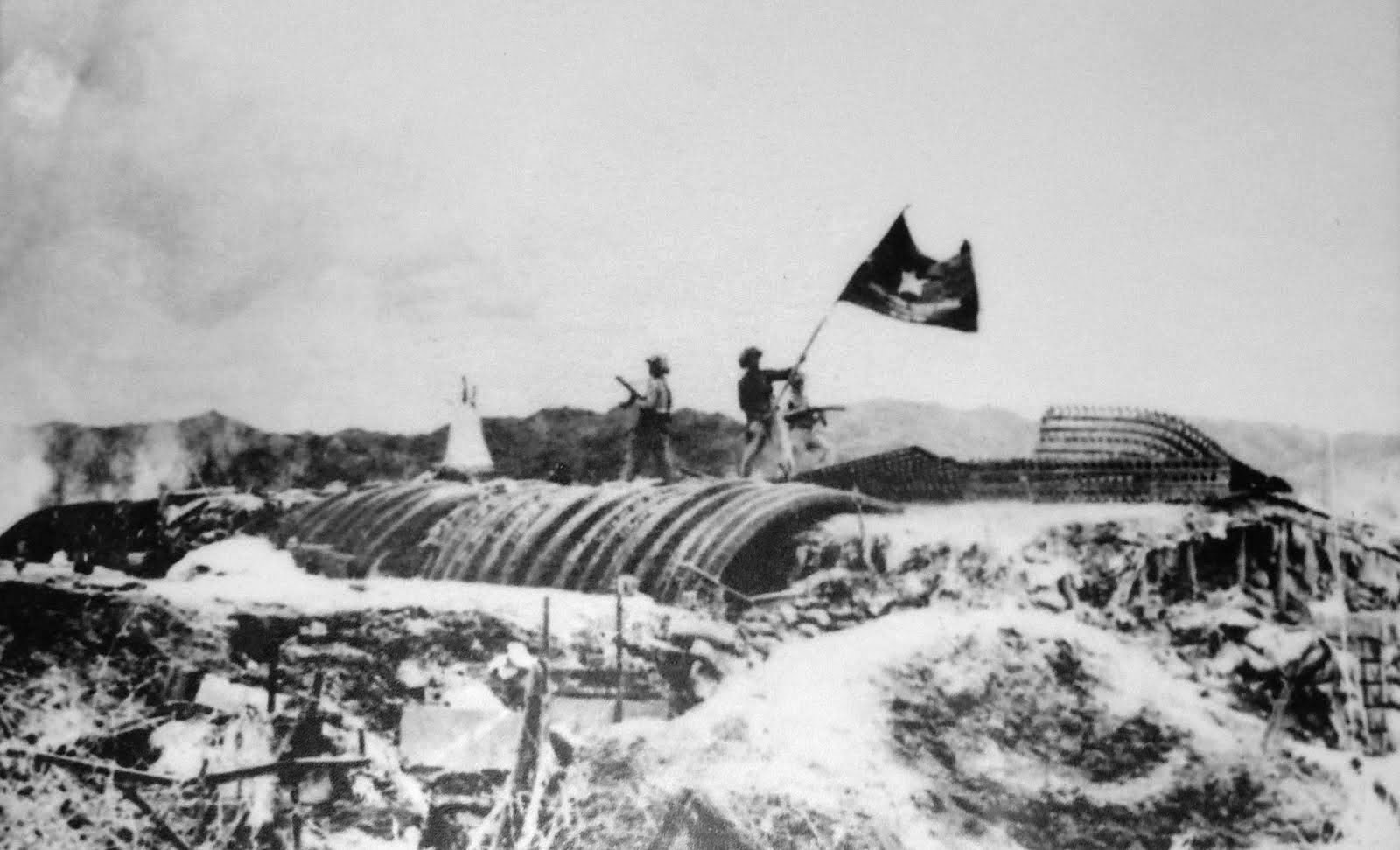
The victory is often told through the image of the red flag with the yellow star planted on the French command post on the last day of the fighting. That scene, reconstructed in textbooks and on murals, has become a true national icon, on a par with the name of the battle itself. Vietnamese children learn it at school; the veterans, ever fewer in number, remain surrounded by immense respect.
What this battle tells, at heart, goes beyond Vietnam. It showed the whole world that a determined people, even less well armed, could stand up to a colonial power — and win. In many countries of Asia and Africa then longing for independence, the name Điện Biên Phủ became a hope. That is why this remote basin in the Vietnamese northwest holds such a singular place: there, in a few weeks of spring, not only the outcome of a war tipped over, but a part of the world order itself. A lesson in willpower, in sweat, and in rice carried on human backs along mountain paths.
Vietnamese to remember
- Điện Biên Phủ (dien bien foo) — the site of the decisive 1954 battle
- chiến thắng (chien thang) — victory
- trận đánh (tran dang) — battle, combat
- Việt Minh (viet minh) — the national liberation front
- Võ Nguyên Giáp (vo nguyen zap) — the general who commanded the victory
- bộ đội (bo doy) — the soldiers of the people's army
- dân công (zan cong) — the civilian porters who supplied the front
- pháo (phao) — cannon, artillery
- núi (nooy) — mountain
- độc lập (dohp lap) — independence
- thực dân (thook zan) — colonialism, colonizer
- Hiệp định Genève (hiep dinh geneve) — the Geneva Accords (1954)