
📜 History · B1
The Trưng Sisters (Hai Bà Trưng)
In the year 40, the Trưng Sisters led the first great revolt against Chinese rule and briefly reigned over an independent kingdom. National heroines, they are honored across the country every year.
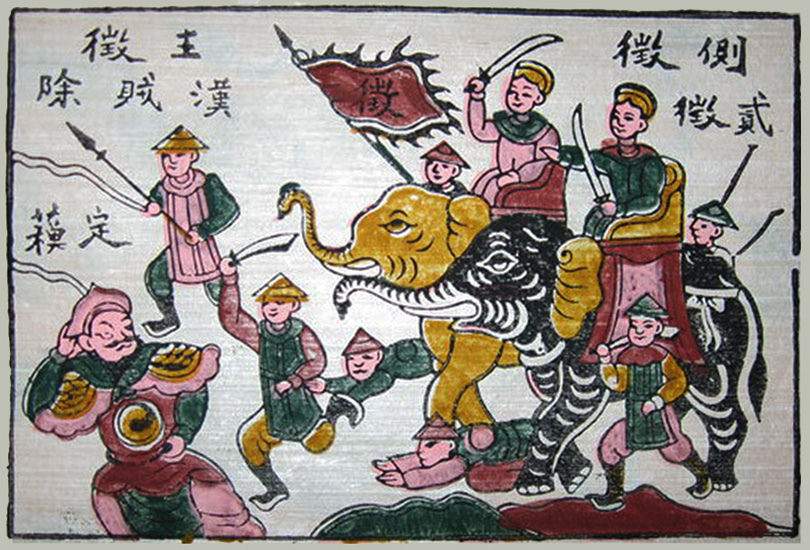
Nearly two thousand years ago, in a land bent under the yoke of a distant empire, two sisters mounted war elephants and raised up an entire people. Their names were Trưng Trắc and Trưng Nhị, and history has joined them forever under a single revered name: Hai Bà Trưng ("hai ba trung"), literally "the two Trưng ladies." Their revolt, the first great Vietnamese uprising against Chinese domination, lasted only a few years, and it ended in defeat. And yet, two millennia later, incense still burns in their memory, streets and schools bear their name, and every child in Vietnam knows their deed. For what the Trưng sisters kindled was not only a war: it was an idea that has never again gone out.
A land under foreign domination
To grasp the significance of their revolt, one must return to the first century CE. The north of present-day Vietnam was then a distant province of the vast Han empire, the great Chinese dynasty. This was the start of what the Vietnamese call the period of Northern domination (Bắc thuộc, "bak thwok") — a very long series of centuries during which the country was administered, taxed, and sinicized by the empires from China.
This domination weighed heavily. Foreign governors and officials imposed their laws, their taxes, their customs. They sought to assimilate the local population, the Lạc Việt, to erase its traditions little by little in favor of the Chinese model. The local chieftains, the lords of the land (the Lạc tướng), saw their power and dignity brought low. Anger rose, muffled, in the countryside and among the humiliated native aristocracy. All that was missing was a spark.
Two sisters, one revolt
That spark came from two women of the local nobility. Trưng Trắc, the elder, was the daughter of a lord, a woman of character, known for her courage and resolve. Her younger sister, Trưng Nhị, stood at her side. According to traditional accounts, the trigger was the execution of Trưng Trắc's husband, a notable named Thi Sách, by the Chinese administration. To personal grief was added the exasperation of an entire people: the private tragedy became the occasion of a general uprising.
In the year 40 CE, Trưng Trắc and Trưng Nhị raised the banner of revolt. And the land answered. Local lords, peasants, and — this is a famous feature of the story — many women joined them. Tradition holds that several of their lieutenants were warrior-women, which has made the Trưng sisters, across the centuries, a powerful symbol of Vietnamese female courage. In a short time the insurrection swept away many strongholds and drove out the Chinese governor, who was forced to flee.
A brief independent kingdom
The uprising was at first a triumph. The Trưng sisters liberated a vast territory and Trưng Trắc was proclaimed queen. For a few years, the land regained a form of independence: after decades of foreign tutelage, a native power once again reigned over the land of the Lạc Việt. It is said that the new queen lightened certain burdens weighing on the people, a highly symbolic gesture of a power that meant to stand close to its own.
This resurrected kingdom was, however, brief and fragile. The Han empire was not one to let a province slip away. The reconquest was not long in coming.
- The Han emperor entrusted an experienced general, Mã Viện (the famous Ma Yuan of the Chinese sources), with the mission of retaking the country.
- This imperial army, seasoned and well organized, marched south to crush the revolt.
- Against such power, the more improvised forces of the Trưng sisters eventually gave way.
The defeat of the year 43
After fierce resistance, the revolt was defeated around the year 43. The armies of Mã Viện prevailed, and the country fell back under the empire's domination. As for the fate of the two heroines, tradition has made it a tale of great tragic nobility: rather than surrender and endure the humiliation of captivity, Trưng Trắc and Trưng Nhị are said to have chosen death, throwing themselves, so the story goes, into the waters of a river. Here again, one must distinguish the established fact — the revolt, the brief kingdom, the defeat by the Han — from the legendary embellishment that, over the centuries, has crowned the sisters' end with a halo of heroic sacrifice.
Their defeat prolonged the long Northern domination, which was to last many more centuries before Vietnam won its independence for good. In military terms, then, the venture of the Trưng sisters was a failure. But in symbolic terms, it was quite the opposite.
Why their memory endured
One might wonder that a lost revolt, crushed after only a few years, should have left so deep a mark. That is precisely where the power of the Trưng sisters lies. Their story is not one of victory, but one of a beginning. They showed, for the first time in dazzling fashion, that foreign domination was not a fate to be endured, that one could rise, unite, take up arms, and — if only for a time — govern one's own land.
That idea did not die with them. Throughout the centuries of Northern tutelage, others rose in their turn — other names, other revolts, other defeats, and, one day, independence finally won. In this long chain of resistances, the Trưng sisters hold the first link, the one remembered as a wellspring. It is said that, later, Vietnamese scholars and sovereigns held them up as an example, as the ancestors of patriotic courage.
There is, too, in their legend, a more intimate lesson than mere military history. The Trưng sisters act together, united, the elder and the younger, the queen and her sister-in-arms. This image of two sisters standing together to the end — even unto death, according to tradition — carries a particular emotional force. It blends family feeling, so central in Vietnamese culture, with the ideal of sacrifice for the homeland. It is this union of heart and duty that, as much as the feats of arms, explains why their memory has crossed two thousand years without fading.
National heroines, forever
For the Trưng sisters won something the Han armies could not take from them: a place at the heart of Vietnamese identity. They were the first to say no, out loud, to foreign domination, to prove that a native power was possible. They opened the long line of figures of national resistance, and every later revolt has, in a sense, remembered them.
The cult of the Hai Bà Trưng has lived for centuries. Temples (đền) have been raised to them, where people come to pay homage, burn incense, pray. Each year a festival is dedicated to them, with processions and ceremonies, often in early spring. Their name is everywhere in the country: great avenues, neighborhoods, schools, and districts are called Hai Bà Trưng. And the image of the two queens perched on their war elephants, swords drawn, is one of the most recognizable visual icons in Vietnamese history.
There is a further dimension, especially dear to Vietnam: the Trưng sisters are women. In a country that likes to recall the role of its heroines, they embody the idea that courage and a sense of national duty have no sex. They are readily cited as the very first in a long tradition of strong Vietnamese women ready to defend their land. It is no accident that, across the country, so many mothers still tell their story to their daughters: over the centuries the two queens have become a way of saying that nothing bars a woman from standing among the greatest figures of the nation.
Even today, when you stroll through a Vietnamese city and come upon a "Hai Bà Trưng" sign at a street corner, or see, on a festival day, a procession honoring the two queens, you touch this living continuity. Two women from two thousand years ago still say something to the Vietnamese of today, as if the thread had never been broken. Few peoples keep the memory of their very first heroines so vividly alive.
Thus what might have been only an unhappy, distant military episode became a founding myth. The Trưng sisters remind every generation of a simple, stubborn conviction, forged two thousand years ago on the back of an elephant: this land is ours, and its freedom is worth rising for.
Vietnamese to remember
- Hai Bà Trưng (hai ba trung) — "the two Trưng ladies," the Trưng sisters
- hai (hai) — two
- bà (ba) — lady, woman (a respectful term)
- Trưng Trắc (trung trak) — the elder sister, proclaimed queen
- Trưng Nhị (trung nyee) — the younger sister
- Bắc thuộc (bak thwok) — the "Northern domination," the era of Chinese tutelage
- giặc (zak) — the enemy, the invader
- voi (voy) — the elephant, war mount of the two queens
- đền (den) — the temple dedicated to a venerated figure
- nữ anh hùng (nu an hoong) — the heroine (heroic woman)
- khởi nghĩa (khoy ngee-a) — the uprising, the insurrection
- độc lập (dok lap) — independence