🗺️ Region · A2
The Mekong Delta
Nicknamed Vietnam's 'rice bowl', the Mekong Delta is a maze of canals, rice fields and fruit orchards. People travel by boat, and floating markets take the place of streets.
Picture yourself at dawn, sitting in the prow of a narrow boat slicing through water the colour of milky tea. All around you the horizon is an endless flatness of green and silver: rice paddies as far as the eye can see, coconut palms leaning over the banks, and already, in the warm mist, the cheerful clamour of a floating market waking up. Women in the loose áo bà ba (the Southern shirt) row standing upright, pyramids of pineapples and watermelons sway on the sampans, and the smell of drip coffee mingles with that of river mud and fresh fish. Welcome to the Mekong Delta, the đồng bằng sông Cửu Long, that great apron of water and silt laid across the far south of Vietnam, which the Vietnamese fondly call the country's "rice bowl."
The land of nine dragons
The river that gives the whole region its name is one of the longest in the world. Born on the Tibetan plateau, it crosses China, Myanmar, Laos, Thailand and Cambodia before reaching Vietnam, where it fans out to meet the sea. The Vietnamese do not call it "Mekong" but sông Cửu Long (song koo-long), literally "the River of Nine Dragons." The name comes from the many branches through which the river empties into the South China Sea: tradition counts nine of them, like nine dragons spitting their waters toward the ocean. Cửu (koo) means "nine" and long means "dragon" — the same long found in Hạ Long ("the descending dragon") or Thăng Long ("the ascending dragon"), the old name of Hanoi. The dragon, in Vietnam, is not a beast to be slain: it is a benevolent creature, linked to water, rain and prosperity. It would be hard to find a truer image for this delta where everything is born of water.
For here, water is queen. The delta is one vast labyrinth of river branches, canals (kênh rạch), ditches and creeks, threaded with thousands of kilometres of waterways. For centuries people did not travel here by road but by boat. The house faces the water, the market is held on the water, and school, church and pagoda are reached by canoe. The rhythm of life follows the tides and the monsoon: the dry season, then the great annual flood which, far from being a catastrophe, lays down fertile silt and brings fish. This rising of the waters is called the mùa nước nổi (moo-a nook noy), "the season of rising water" — a time when the fields turn into lakes, when people fish where yesterday they farmed.
Vietnam's rice bowl
If the delta earns its nickname of "rice bowl" (vựa lúa, voo-a loo-a, "the rice granary"), it is because it produces an enormous share of Vietnam's rice, and a considerable share of the rice the country exports — Vietnam ranking among the very top exporters in the world. Thanks to the tropical climate and the river's silt, farmers here often harvest two, sometimes three rice crops a year. The paddies, those ruộng lúa (roo-ong loo-a) gridded with earthen dikes, change colour week by week: the tender green of freshly transplanted seedlings, the deep green of full growth, then the heavy gold of ears ready for harvest.
But the delta does not live on rice alone. It is also Vietnam's great orchard. The vườn cây ăn trái (voo-un kay an trai), the fruit orchards, groan under an abundance that astonishes visitors from the North: bristly rambutans, purple mangosteens, longans, pungent durians, enormous jackfruit, pomelos, mangoes, soursops, coconuts with sweet flesh. Provinces such as Bến Tre are so blanketed in coconut palms that Bến Tre is nicknamed "the land of coconuts." There they make a famous soft coconut caramel, kẹo dừa (keo zuh), chewed while still warm, wrapped in its thin edible rice paper.
And then there is fish. In this world of fresh and brackish water, fishing and aquaculture feed millions. The catfish (cá tra, ca tra), farmed in the river's branches, has become a major export. In the markets, basins teem with live fish, shrimp, paddy crabs and snails. The delta's cooking draws frank, generous dishes from all this: cá lóc nướng trui (ca lok nuong troo-i), a snakehead fish skewered on a stick and grilled over burning rice straw, or the beloved canh chua (kang choo-a), a sweet-and-sour soup with tamarind, herbs and fish, one of the most cherished dishes of the South.
Floating markets, a civilisation on the water
If one had to choose a single image to capture the delta, it would surely be that of the floating market, the chợ nổi (chuh noy). Long before roads linked the villages, trade was done on the water. At dawn, dozens, sometimes hundreds of boats converge on a stretch of river to buy and sell the region's fruit and vegetables wholesale. Each boat hoists its wares at the top of a long pole planted at the bow: this is the cây bẹo (kay beo), the "signpost tree." A watermelon fixed at the top, and everyone understands watermelons are for sale; a bunch of pineapples, and pineapples are announced. No need to shout: the goods can be seen from afar, read on the water like a living billboard.
The most famous floating markets are held around the delta's great city. The one at Cái Răng, near Cần Thơ, is the largest and liveliest: in the early morning you glide between boats laden with fruit, while small craft weave through selling hot coffee, hủ tiếu soup (hoo tee-oo, a noodle soup typical of the South) and bowls of bún passed from boat to boat. You eat breakfast on the water, one knee tucked up, watching the sun rise over the river. These markets, shaped by generations of river life, are today both a place of commerce and a living heritage that people are working to preserve.
Cần Thơ, capital of the river
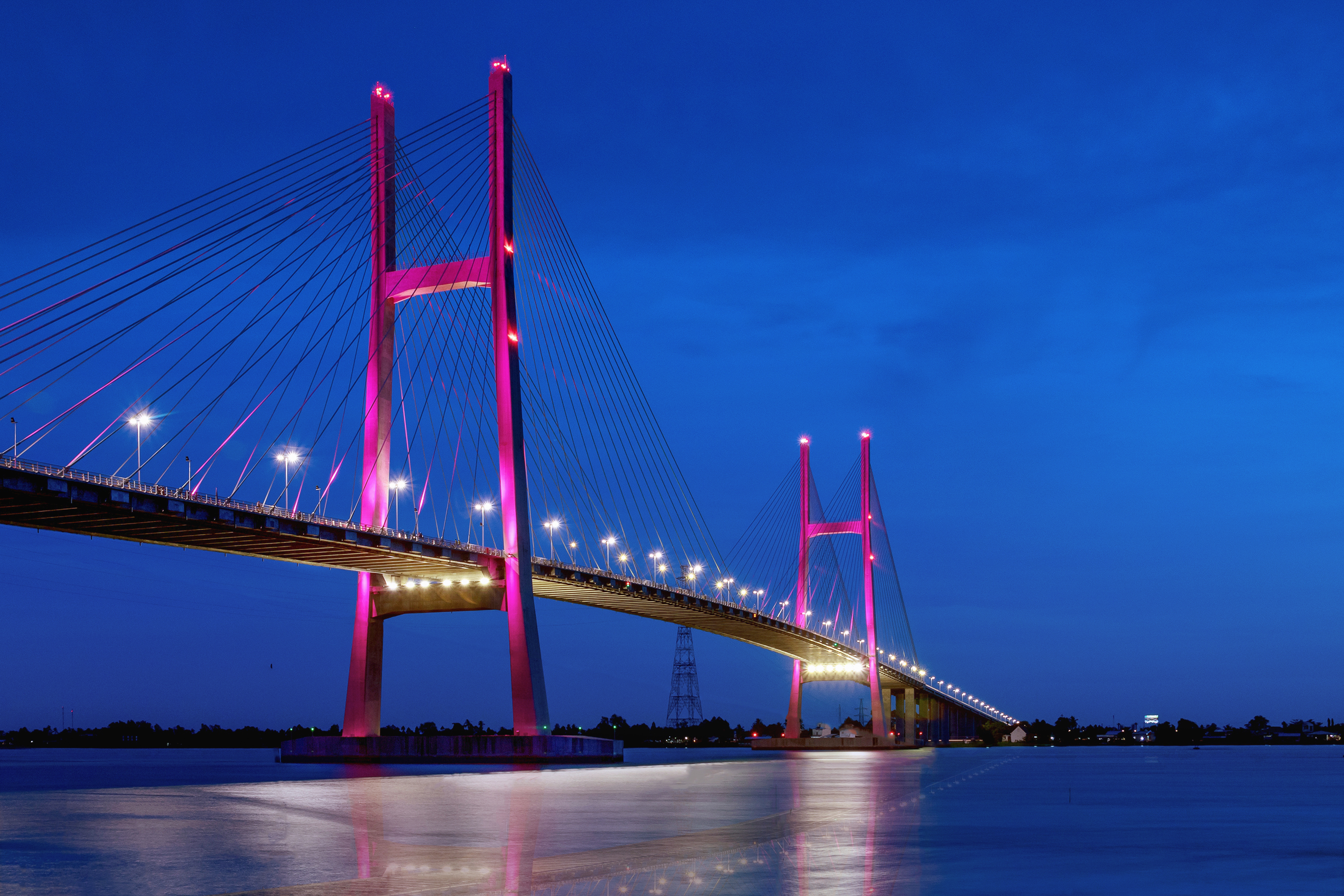
At the heart of the delta stands Cần Thơ, its largest city, nicknamed Tây Đô (tay doh), the "Western Capital." Set on the bank of the Hậu River (one of the great branches of the Mekong), it is the economic, academic and cultural crossroads of the whole region. In the evening the Ninh Kiều quay comes alive: families out strolling, skewer vendors, lit-up boats offering dinner cruises along the water. The city blends provincial calm with a distinctly Southern energy — generous and direct.
The Vietnamese South has a reputation for character: its people are said to be open, spontaneous, quick to invite a stranger to share a meal. The delta's history partly explains this temperament. A land of late settlement, won from the marshes and cleared over centuries, peopled by the Kinh (the majority Vietnamese) but also by Khmers, Chinese and Chams, it is a region of mixing and pioneers, where people learned to reckon with water, mud and the unexpected. Golden-roofed Khmer pagodas, Chinese temples and churches stand side by side without friction. This diversity is tasted in the food too, and heard in an unmistakable Southern accent — more sing-song, with certain sounds softened.
A fragile balance
The Mekong Delta is a miracle of fertility, but a fragile one. A vast plain barely higher than the sea, it stands on the front line against rising waters and the intrusion of salt, which pushes up the river's branches in the dry season and threatens the paddies and orchards. Upstream, dams and water withdrawals alter the river's flow and the amount of silt that travels down to here — the very silt that has always remade the land each year. The people, like their ancestors, adapt: they switch crops, reshape the canals, invent. This constant dialogue between people and water is perhaps the delta's true soul — a place where the river was never really tamed, but where people learned to dance with it.
To leave the delta is to carry away images that cling to the skin: the pole of a floating market rising in the mist, the sweet taste of a ripe mango chosen at the water's edge, the lapping of an oar, and that peculiar Southern light, thick and golden, that seems to rise straight out of the River of Nine Dragons.
Vietnamese to remember
- sông Cửu Long (song koo-long) — the River of Nine Dragons, the Vietnamese name for the Mekong
- đồng bằng (dong bang) — the plain, the delta
- chợ nổi (chuh noy) — the floating market
- cây bẹo (kay beo) — the signpost pole at a boat's bow showing what is for sale
- ghe / xuồng (geh / soo-ong) — the boat, the sampan of the delta
- vựa lúa (voo-a loo-a) — the rice granary, the "rice bowl"
- ruộng lúa (roo-ong loo-a) — the rice paddy
- mùa nước nổi (moo-a nook noy) — the flood season, when high water covers the fields
- cá tra (ca tra) — the catfish farmed in the river
- canh chua (kang choo-a) — the sweet-and-sour tamarind soup, emblem of the South
- kẹo dừa (keo zuh) — the soft coconut caramel of Bến Tre
- Tây Đô (tay doh) — "the Western Capital," nickname of Cần Thơ