
🎵 Music · B1
Vietnamese music
From traditions like ca trù to today's V-pop hits.
Close your eyes in a Hà Nội alley as evening falls. From one window escapes the drawn-out wail of a single string that seems to weep and sing at once; from a nearby café, a V-pop hit makes the speakers throb, all synths and catchy hooks. Between those two sounds lie a thousand years of history, and yet they share the same street. Vietnamese music is exactly that: a thread stretched between the court songs of emperors and the video clips millions of young people watch on their phones. Let us follow that thread.
An instrument that sings almost like a voice: the đàn bầu
Let us begin with the strangest and most moving sound in the country: that of the đàn bầu ("dan bau"), the monochord zither. A single string stretched over a long wooden body, a flexible rod at one end, and a gourd that serves as a resonator. The player plucks the string while touching the harmonics and bending the rod: the sound slides, ripples, rises and falls continuously, imitating almost perfectly the inflections of the human voice — and of Vietnamese, a tonal language.
This is no accident. Vietnamese is a tonal language: depending on the melody with which you pronounce a syllable, the meaning changes completely. The word ma can mean "ghost," "but," "cheek," "horse," "tomb" or "rice seedling," solely according to its tone (ma, mà, má, mã, mạ…). An instrument able to glide between pitches like the đàn bầu naturally embraces a language that already sings when spoken. A proverb even mischievously advises young women not to listen too much to the đàn bầu, so bewitching is its song.
Three regions, three voices
Vietnam is often read in three: the North, the Center, the South — and so is its traditional music.
- The North, around Hà Nội and the Red River delta, is the cradle of the oldest and most learned forms: ca trù and quan họ.
- The Center, with the former imperial city of Huế, keeps the refined music of the court, nhã nhạc.
- The South, warm and riverine, gave rise to đờn ca tài tử ("duhn ka tai tuh"), a convivial chamber music born in the Mekong delta and likewise recognized by UNESCO.
Each region has its timbres, its scales, its ways of holding the voice. To travel through Vietnam is also to travel from one music to another.
Quan họ: singing in pairs, boys against girls
Among the North's treasures, quan họ ("kwan ho") is perhaps the most charming. It is an antiphonal song (hát đối đáp, "singing in reply"): a group of boys and a group of girls throw verses back and forth in turn, like a poetic, amorous dialogue. One poses a sung question, the other must answer on the same melody, sometimes improvising, never breaking the thread.
Traditionally tied to the villages of Bắc Ninh province, quan họ was sung at spring festivals, often a cappella, the singers in the four-panel dress áo tứ thân and wearing the flat hat nón quai thao. It is a music of encounter, of discreet courtship and shared virtuosity. Quan họ is today inscribed on UNESCO's list of the intangible cultural heritage of humanity.
Ca trù: the learned poetry of the literati
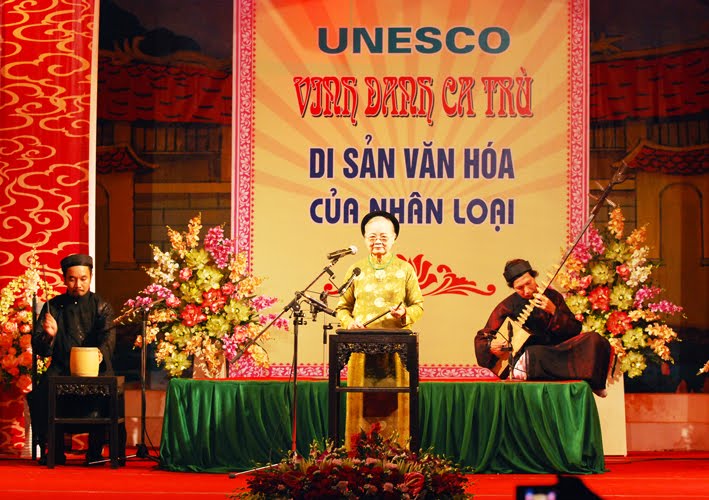
More austere and more scholarly, ca trù ("ka choo") was the music of the literati and the song houses of the North. In it a singer unspools a classical poem in an ornamented voice, while marking the rhythm on small bamboo clappers, the phách. She is accompanied by a long-necked lute, the đàn đáy, and a connoisseur, seated, punctuates the performance with strokes of a praise drum (the trống chầu) to salute the finest passages.
This highly refined art nearly disappeared in the twentieth century before being rediscovered and protected. It too figures on UNESCO's lists, as a heritage in urgent need of safeguarding. To listen to ca trù is to enter a world of subtlety, where silence and restraint count as much as the note.
Nhã nhạc: the elegant music of the Huế court
At Huế, the former imperial capital on the banks of the Perfume River (sông Hương), resounded nhã nhạc ("nya nyak"), literally "elegant music." It was the official music of the court of the Nguyễn emperors, played during ceremonies, rites and great occasions. Large ensembles blended strings, winds and percussion in a solemn and colorful display.
The nhã nhạc of the Huế court was one of the first Vietnamese arts recognized by UNESCO as a masterpiece of the oral and intangible heritage of humanity. Even today you can hear reconstructions of it in the imperial city, among the red walls and tiled roofs.
When music becomes theater
In Vietnam, music is not only for listening: it is played on stage. Several forms of sung theater make it the heart of their art. In the North, chèo ("cheo") is a popular village theater, born in the paddies of the delta, blending song, dance and satirical comedy, where the audience knows the tunes so well that they hum along. More scholarly and more codified, tuồng ("twong"), or hát bội, is a classical opera with spectacular makeup and stylized gestures, inherited in part from influences that came from Chinese theater.
In the South, a more recent form has won hearts: cải lương ("kai luong"), literally "reformed theater," which appeared in the early twentieth century in the Mekong delta. It marries traditional melodies, an orchestra and melodramatic plots, and it remains immensely popular, on television as on stage. Its signature song, the famous vọng cổ ("vong ko"), melts whole generations of spectators.
One must also mention a cousin unique in the world: water puppet music, múa rối nước ("moo-a zoy nuoc"). On a pool, wooden puppets emerge and dance, worked by puppeteers hidden in the water behind a curtain, while a small traditional orchestra accompanies the scene live. Born in the villages of the North, this art brings out gongs, drums and songs through vignettes drawn from peasant life and legend.
The palette of instruments
Vietnam possesses a family of traditional instruments whose names often begin with đàn ("dan"), which denotes a stringed instrument. A few traveling companions:
- đàn bầu — the monochord zither, met already
- đàn tranh ("dan chan") — a long zither of sixteen strings (or more), with crystalline tones, cousin of the Japanese koto and the Chinese guzheng
- đàn nguyệt ("dan ngwet") — the "moon lute," its body round like the full moon, very present in northern songs
- đàn tỳ bà — a pear-shaped lute, close to the Chinese pipa
- sáo ("sao") — the bamboo flute, supple and pastoral
- trống ("trong") — the drum, backbone of the rhythm
Each has its color, and together they form the soundscape of festivals, theaters and temples.
From tradition to V-pop
Let us leap into the present. Today Vietnamese youth listen above all to V-pop ("Vietnamese pop music"), a teeming scene of ballads, rap and danceable tracks. Its most famous figure is surely Sơn Tùng M-TP ("suhn tung"), a polished star whose videos draw enormous online audiences and who has turned Vietnamese pop into a mass phenomenon.
What is fascinating is that the two worlds do not always ignore each other. More and more artists slip a đàn bầu, a đàn tranh or a quan họ melody into a modern track, marrying ancient tones with today's beats. Vietnamese music is therefore not a museum: it is a living organism, where the single string of the monochord keeps vibrating, quietly, beneath the bass of V-pop.
Vietnamese to remember
- âm nhạc (uhm nyak) — music
- đàn bầu (dan bau) — the monochord zither, sounding close to the voice
- đàn tranh (dan chan) — the multi-stringed zither with crystalline tones
- đàn nguyệt (dan ngwet) — the round-bodied "moon lute"
- quan họ (kwan ho) — antiphonal boy-girl singing, UNESCO heritage
- hát đối đáp (hat doy dap) — to sing in reply, in dialogue
- ca trù (ka choo) — the learned song of the northern literati
- nhã nhạc (nya nyak) — "elegant music," the court music of Huế
- sáo (sao) — the bamboo flute
- trống (trong) — the drum
- cải lương (kai luong) — the sung "reformed theater" of the South
- múa rối nước (moo-a zoy nuoc) — water puppet theater
- ca sĩ (ka see) — a singer
- nhạc pop (nyak pop) — pop music (V-pop)