
🍜 Food · A1
Vietnamese iced coffee
Iced coffee with condensed milk, brewed with a phin filter. Strong, sweet and refreshing.
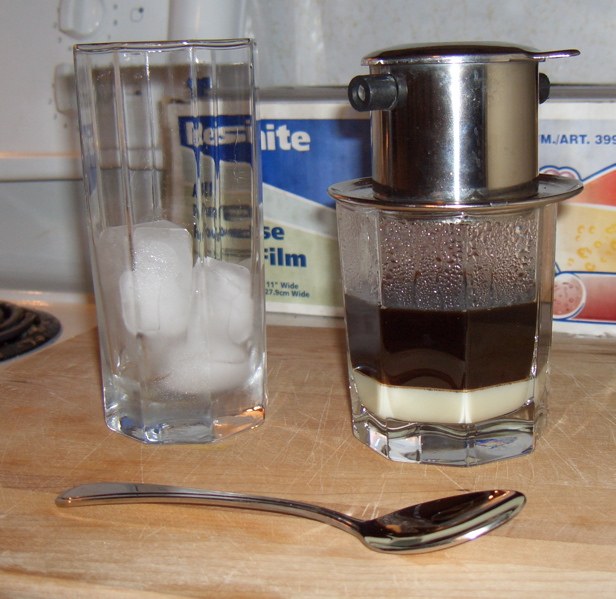
Sit down on a little plastic stool, facing the street, in the muggy heat of a Vietnamese afternoon. Before you, a glass and a small metal filter resting on top. Drop by drop, a thick black coffee falls slowly into a layer of sweetened condensed milk. Time slows down. You have nothing to do but wait, watch the motorbikes go by, and let the coffee make itself. Then you stir, pour it all over ice cubes, and raise to your lips the cà phê sữa đá — iced coffee with condensed milk, one of Vietnam's most delicious institutions. Strong, sweet, ice-cold, comforting: a concentrate of a whole way of life.
Let's break down the name
Vietnamese has this wonderful habit of naming things by their ingredients, in order. Cà phê sữa đá decodes, word by word, like this:
- cà phê ("ka fe") — coffee. The word comes directly from the French "café," a memory of the colonial era.
- sữa ("suh-a") — milk (here, sweetened condensed milk).
- đá ("dah") — ice, the ice cubes.
So, literally: "coffee-milk-ice." Once you hold these three words, you can order every variation. Want the same but hot? Ask for a cà phê sữa nóng (nóng = hot). Prefer it black and iced, without milk? That'll be a cà phê đen đá (đen = black). The Vietnamese of coffee has a crystal-clear logic and builds like a set of Lego bricks.
The phin, the art of slowness
The emblematic tool of Vietnamese coffee is called the phin (pronounced "fin"). It's a small individual metal filter, made of a cup pierced with tiny holes, a chamber where you put the ground coffee, and a disk that presses down the grounds. You set it directly on the glass, fill it with hot water, and gravity does the rest.
Brewing with the phin is slow — several minutes during which the coffee falls drop by drop. And therein lies all the charm: the phin imposes the wait. It forces you to settle, to do nothing, to contemplate. In a country where life races along, this little ritual is a parenthesis of calm. Watching the coffee drip, drop after drop, is almost meditative. It's sometimes said that Vietnamese coffee isn't merely drunk: it is first contemplated.
Robusta, a strong character
Where much of the world swears by arabica, mild and aromatic, Vietnam is the kingdom of robusta. This coffee variety, grown mainly on the central highlands (the Tây Nguyên, around the city of Buôn Ma Thuột), produces stronger, more bitter beans, and above all far richer in caffeine than arabica. Robusta has a powerful, almost chocolatey body, a frank bitterness that can surprise.
It is precisely this robustness that explains the condensed milk. In colonial times, fresh milk was rare and kept poorly in the tropics. Sweetened condensed milk, in a can, was the practical solution. But the marriage proved brilliant: the creamy, sweet softness of the milk tames the biting bitterness of the robusta, creating a perfect balance between strength and roundness. Vietnamese coffee is no accident: it's a clever answer to a terroir and a history.
A global coffee power
Few people know it, but Vietnam is one of the largest coffee producers and exporters in the world — regularly ranked the second-largest exporter globally, and by far the first for robusta. Coffee isn't just a drink here: it's a major industry, a pillar of the agricultural economy, and an immense source of national pride.
This story is recent and dazzling. Coffee was introduced by the French in the 19th century, but it was mainly from the late 20th century that the country became a global giant, turning the highlands into a sea of coffee trees. Today, a major Vietnamese coffee brand is known throughout the country, and modern coffee chains compete with traditional stalls. Coffee literally irrigates Vietnam's culture and economy.
Cà phê trứng, egg coffee
You cannot speak of Vietnamese coffee without mentioning its most surprising creation: cà phê trứng, egg coffee (trứng = egg). Born in Hanoi, it's said, at a time when milk was scarce, it consists of whisking an egg yolk with sweetened condensed milk until you obtain a thick, airy, golden foam, which is laid over hot black coffee.
The result is baffling at first, then winning: it tastes nothing like egg, but rather like a creamy custard, almost a liquid tiramisu, a dessert and a drink at once. You enjoy it as much with a small spoon as by the sip. It has become a cult specialty of the capital, and a must for any lover of culinary curiosities.
A whole family of coffees
Cà phê sữa đá and cà phê trứng are only the tip of a vast repertoire. Vietnamese coffee comes in a host of creations, and knowing a few always pleases the server:
- bạc xỉu ("bak syew") — the sweet, milky version, with far more condensed milk than coffee. The name comes from a Sino-Vietnamese expression meaning roughly "a little coffee, a lot of white milk." It's the coffee of those with a sweet tooth, and often the one through which children discover the drink.
- cà phê muối ("ka fe moo-ee") — salted coffee, a specialty from the city of Huế, in the center. A lightly salted cream crowns the coffee; the salt, against all expectation, rounds out the bitterness and brings out the sweetness. A find that recently won over the whole country.
- cà phê cốt dừa ("ka fe kot zuh-a") — coconut-cream coffee, creamy and exotic, where coconut replaces or complements the milk.
- cà phê dừa, cà phê sữa chua (with yogurt), and a thousand other local variations.
This inventiveness says something about the Vietnamese relationship to the drink: coffee here is never fixed, it is played with, reinvented, adapted to tastes and regions. Every town, every stall cultivates its own little touch. Behind each glass there is an idea, a story, sometimes a local pride.
Coffee as a place to live
Beyond the drink, coffee in Vietnam is a place and a time. Cafés (quán cà phê) are everywhere, from tiny sidewalk stalls with their low stools to sleek, air-conditioned establishments. People go for everything: to discuss business, meet friends, cram for exams, take a break, or simply sit and watch life go by — an activity in itself, almost a national sport.
There is something deeply social in Vietnamese coffee. You don't gulp it down standing at a counter: you take your time. The ritual of waiting for the phin, the deliberate slowness, the small iced glass you make last: all of this sketches a philosophy of daily life, a way of resisting haste, of granting yourself a pause of sweetness. In the din of horns and the heat of the asphalt, coffee is an oasis.
There's an expression, in fact, that keeps coming up in Vietnamese cafés: "từ từ" ("tuh tuh"), meaning "slowly, unhurriedly, gently." It's almost a motto. Coffee isn't drunk like an espresso downed standing between two meetings: it stretches out, it accompanies a lingering conversation, a game of Chinese chess on the sidewalk, a downpour you watch fall. This chosen slowness, in the middle of a country that otherwise moves at a frantic pace, is perhaps the finest lesson of Vietnamese coffee: knowing, now and then, to do nothing but savor the moment.
So next time, order a cà phê sữa đá. Wait for the phin to finish its work. Stir the golden milk into the deep black. Pour over the ice, listen to the clink of the cubes. And drink slowly: you're not just tasting a coffee, you're tasting the patience, the ingenuity and the sweetness of living of an entire country.
Vietnamese to remember
- cà phê (ka fe) — coffee (from the French "café")
- sữa (suh-a) — milk (sweetened condensed)
- đá (dah) — ice, ice cubes
- cà phê sữa đá (ka fe suh-a dah) — iced coffee with condensed milk
- nóng (nawng) — hot
- cà phê đen đá (ka fe den dah) — black iced coffee, no milk
- phin (fin) — the individual metal coffee filter
- cà phê trứng (ka fe truhng) — egg coffee
- quán cà phê (kwan ka fe) — a café (the establishment)
- Tây Nguyên (tay ngwen) — the Central Highlands, the coffee region
- bạc xỉu (bak syew) — very milky, sweet coffee
- cà phê muối (ka fe moo-ee) — salted coffee, a Huế specialty