
🍜 Food · A1
Bánh mì
The Vietnamese sandwich: a crisp baguette filled with meat, pâté and pickled vegetables.
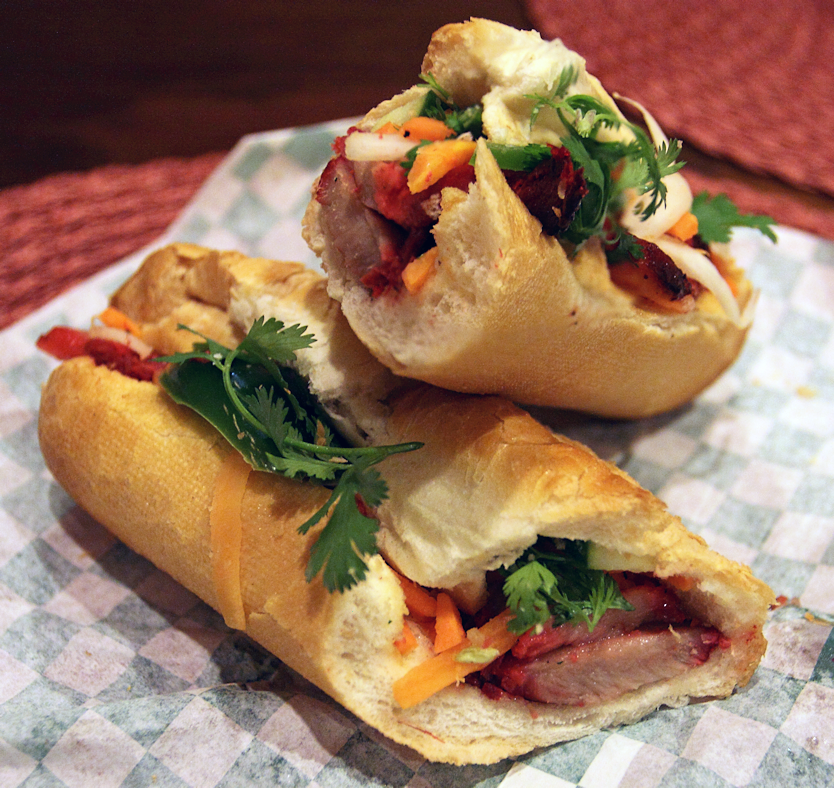
A crunch. That is the first sound of bánh mì, when your teeth break through the golden crust of a still-warm baguette. Then, in order, an avalanche of flavors: the softness of the pâté, the saltiness of the meat, the bright acidity of the pickled vegetables, the peppery scent of cilantro, the bite of a chili, a dash of sauce. In a single mouthful, a whole slice of Vietnamese history explodes on your palate. For bánh mì (pronounced "bun mee") is no ordinary sandwich: it is the delicious fruit of an encounter between two worlds, colonial France and Vietnam, transformed by popular genius into one of the finest street snacks on the planet.
One word, one history
In Vietnamese, bánh mì literally means "wheat bread." The word bánh denotes a whole family of flour-based foods (cakes, pancakes, breads), and mì refers to wheat. Originally, then, "bánh mì" simply meant the bread itself — the baguette the French introduced to Vietnam during the colonial era, from the 19th century onward. By extension, the word came to mean the entire sandwich.
Here lies all the beauty of bánh mì: it is born of a colonial legacy, but the Vietnamese did not merely endure it, they reinvented it. They took the French baguette and adapted it, transformed it, married it to their own flavors. The result is neither wholly French nor exclusively Vietnamese: it is an original creation, a living symbol of cultural fusion, where the former colonizer and the colonized meet, against all odds, in the same savory bite.
The baguette, but not just any baguette
It all starts with the bread, and the bánh mì baguette is not the Parisian one. Vietnamese bakers made it lighter and crispier. The secret: rice flour is often blended with the wheat flour. The result is a thinner baguette, with an extremely crackly crust and a very airy, almost hollow crumb. This lightness is essential: it keeps the sandwich from being heavy and stodgy, and lets the crust crackle at every bite without crushing the filling.
A good bánh mì is first a good bread, ideally served warm, fresh from the oven or passed briefly over coals to revive its crunch. In the humid tropics, this airy texture is a small miracle of adaptation.
The anatomy of a bánh mì
Open a bánh mì and you'll discover a precise architecture, where each element plays a role. It is an exercise in balance between fat, salt, acid, herb and heat. The classic components:
- pâté (pa tê) — a creamy liver pâté, generously spread, a direct legacy of French charcuterie
- a fat — often butter or a homemade mayonnaise, sometimes both, for roundness
- the meat — here the variety explodes: grilled pork, pork belly, chả lụa (a steamed pork sausage, pink and springy), chicken, sardines, meatballs... One of the most beloved versions is bánh mì thịt, filled with an assortment of cold cuts.
- the đồ chua ("sour thing") — pickled vegetables, typically carrot and white radish (daikon) cut into fine sticks and steeped in a mix of vinegar and sugar. This is the stroke of genius: their crunchy acidity cuts the fat and lights up the whole sandwich.
- cucumber in thin strips, for freshness
- cilantro (rau mùi / ngò) — its peppery freshness is indispensable
- fresh chili (ớt) — for those who like heat
- a touch of soy sauce (xì dầu) or Maggi seasoning, that liquid aroma adopted by the Vietnamese, which brings the final umami
Stack all of this into the light baguette, and you get a symphony of textures and tastes. The tour de force of bánh mì is precisely this balance: nothing dominates, everything answers everything else.
A festival of variations
There is not one bánh mì but a thousand. Every region, every vendor, every family has its version. Across the country you meet:
- bánh mì thịt nướng — with marinated grilled pork, fragrant and sweet-savory
- bánh mì xíu mại — with pork meatballs in tomato sauce
- bánh mì chả — with Vietnamese sausage
- bánh mì ốp la — with fried eggs, often served at breakfast
- vegetarian versions (bánh mì chay), very common around Buddhist pagodas, where tofu and seitan replace the meat
This diversity is the dish's richness. Bánh mì adapts to every budget, every hunger, every moment of the day. It is the meal of the rushed worker, the schoolchild, the partygoer heading home at dawn.
The street as theater
Bánh mì is above all a street food. You buy it from a xe bánh mì, those little glass carts on street corners, where the vendor assembles your sandwich in a few precise, rapid gestures: she splits the baguette, spreads pâté and butter, arranges the cold cuts, tosses in a handful of đồ chua, a few sprigs of cilantro, a drizzle of sauce, closes it, wraps it in paper, and hands it to you in under a minute. All for a few thousand dong, a handful of change.
It is this accessibility that made bánh mì a pillar of Vietnamese daily life. Cheap, filling, fast, portable: it is the very definition of a good snack. And yet, every bite tells a story of creativity and adaptation, of how a people took a foreign bread and made it something deeply, joyfully their own.
From colonial bread to the people's sandwich
The story of bánh mì is one of slow appropriation. At first, in colonial times, the baguette was an imported product, expensive and associated with the French and the elites. It was eaten "the French way," with butter, cheese, Western cold cuts — a rich person's bread, in short, foreign to the daily life of most Vietnamese.
Everything shifts in the mid-20th century. Local bakeries multiply, the baguette lightens with rice flour, and above all the Vietnamese begin to fill it their own way: they slip in their own flavors, the tangy đồ chua, the cilantro, the chili, the Maggi sauce, transforming the Western bread into a fully Vietnamese snack. It was in Saigon, it's often said, that the modern bánh mì — this complete, affordable sandwich sold on street corners — truly took off and became a popular food, one for everyone and every day.
Then comes the story of the diaspora. After the great upheavals of the 1970s, many Vietnamese emigrated and carried their cuisine with them. Bánh mì then settled into the Vietnamese neighborhoods of America, France, Australia, where it won over new palates. A savory irony of history: a bread from Europe, reinvented in Asia, sets off to conquer the West in an entirely new form. Today, each region of Vietnam claims its own style — the town of Hội An, in the center, is for instance famous for its particularly celebrated bánh mì — but everywhere the principle stays the same: a crusty baguette, a generous heart, and that miraculous balance between cultures.
A symbol that conquered the world
The word bánh mì has now entered the great international dictionaries, recognized as a proper noun, untranslatable. From New York to Melbourne, bánh mì stalls flourish, and food critics celebrate the sandwich as one of the best in the world. It is a Vietnamese pride, a crunchy ambassador for a whole country.
The best moment to enjoy it? Surely early in the morning, when the baguette has just come out of the oven and the vendor is setting up her cart in the relative cool of dawn. But truthfully, bánh mì keeps no schedule: a standing breakfast before work, a midday snack, an improvised supper on the way home. It's eaten straight from the paper, without cutlery, walking if need be, taking care only to tilt the baguette slightly so as not to lose a crumb of filling. It is a democratic food in the noblest sense: the minister and the laborer bite into the same sandwich, at the same street corner, for the same trifling price.
So bite in, listen to the crunch, let the flavors unfold. You are holding a small masterpiece of history, commerce and ingenuity — the delicious proof that sometimes painful encounters between peoples can, in time, give birth to wonders.
Vietnamese to remember
- bánh mì (bun mee) — the Vietnamese sandwich; literally "wheat bread"
- bánh (bun) — family of flour-based foods (cakes, breads)
- mì (mee) — wheat; by extension, wheat noodles
- đồ chua (doh chwa) — the pickled vegetables (carrot, white radish)
- pa tê (pah teh) — pâté, borrowed from French
- chả lụa (cha lwa) — steamed pork sausage
- thịt (tit) — meat
- rau mùi / ngò (rau mooy / ngaw) — cilantro
- ớt (ut) — chili
- xì dầu (see zoh) — soy sauce
- bánh mì thịt (bun mee tit) — bánh mì filled with cold cuts
- bánh mì chay (bun mee chai) — vegetarian bánh mì