
✦ Culture · A0
The áo dài
The traditional outfit: a long split tunic worn over silk trousers.
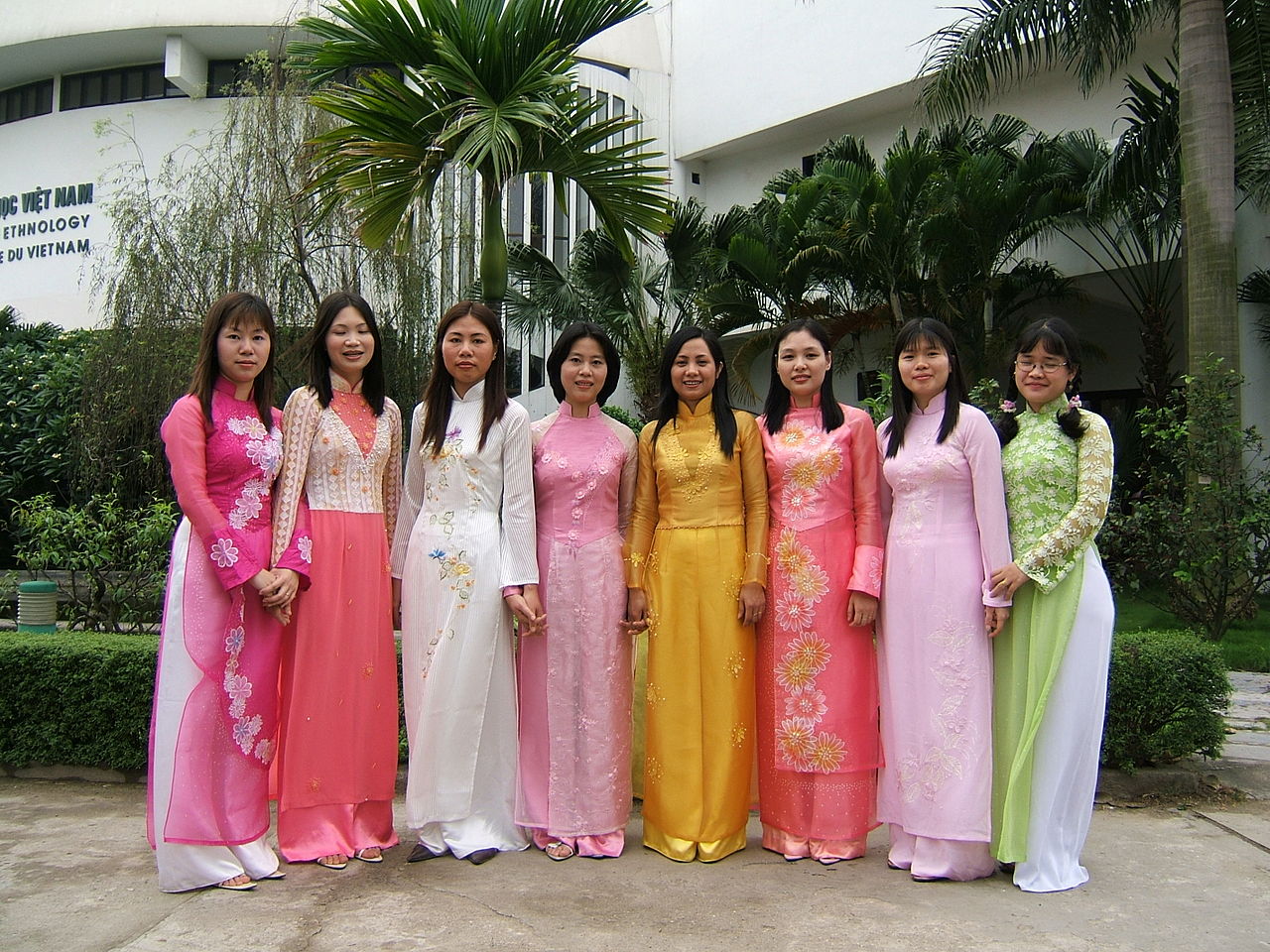
Some images, all on their own, speak a whole country. For Vietnam, here is one: a silhouette gliding by bicycle along an ochre wall, a long silk tunic rippling in the wind, slit high on the sides, hinting at the white trousers beneath, a panel of cloth floating like a sail. This outfit is the áo dài (pronounced "ao zai" in the North, "ao yai" in the South). Two little words that say it all: áo ("ao"), the garment, and dài ("zai / yai"), long. The "long garment." It is the national dress of Vietnam, worn by women — and sometimes men — in life's great moments, and one of the most elegant sartorial translations of a culture anywhere in the world.
Anatomy of a garment
Let us describe it, because its genius lies in its cut. The áo dài is made of two pieces. First, a long tunic falling to the ankles, fitted close to the body over the bust and waist, then slit on each side at the hip. From that slit come two long panels, one in front, one behind, floating freely with every step. Beneath it, one wears loose, flowing trousers, often silk, usually white or matched to the tunic. The collar is traditionally high, in the Chinese manner.
The result is a studied paradox: the garment covers almost the whole body — ankles, arms, neck — and yet it hugs every curve and suggests the grace of movement. It is nicely said to "cover everything but hide nothing." Silk, the reigning fabric of the áo dài, catches the light, ripples, whispers. Walking in an áo dài imposes a certain bearing, a dignified slowness: the body straightens, the gestures grow calm.
A long history of cuts and reforms
The áo dài did not always have this silhouette. It descends from a long lineage of Vietnamese robes. Under the Nguyễn dynasty, in centuries past, the Vietnamese already wore a long robe buttoned on the side, the áo ngũ thân, "the five-panel robe," full and layered, very different from the modern silhouette.
The decisive turning point came in the 1930s. In Hà Nội, artists and designers modernized the cut. The most famous figure is the painter and couturier Nguyễn Cát Tường, known by the French-styled name Le Mur (a pun: tường means "wall" in Vietnamese). Influenced by the Western fashion of his time, he rethought the robe: he fitted it to the body, lengthened the line, streamlined the panels, played on fluidity. From these reforms was born the modern áo dài, tailored and slender, the one we recognize today. The cut would keep evolving over the decades — longer or shorter panels, higher or lower collar, more body-hugging versions — but the essential silhouette was fixed there.
It should be noted that this elegance had its eclipses: in certain periods, amid austerity and reconstruction, the áo dài was judged impractical and grew rare in everyday life. It returned in force from the 1980s and 1990s, rehabilitated as a national pride, and has never left center stage since.
When is the áo dài worn?
The áo dài is not everyday wear for most Vietnamese; it is reserved for the moments that matter, which keeps all its prestige intact.
- At school. In many high schools, especially for girls, the white áo dài is the uniform, at least on certain days of the week or for ceremonies. White evokes the purity and innocence of youth. A Vietnamese schoolyard at closing time, with its dozens of white silhouettes gliding by on bicycles, is an unforgettable sight.
- At weddings. The bride often wears a ceremonial áo dài, usually red or gold — the colors of happiness and luck — richly embroidered with phoenixes, dragons, or flowers. Families, too, dress in their finest áo dài for the celebration.
- At Tết, the Lunar New Year, out come the áo dài to visit relatives, go to the temple, pose for photos before the blossoming apricot branches.
- In public-facing professions: hostesses, hotel receptionists, airline staff, and teachers wear the áo dài as elegant professional attire.
The language of colors
The colors of the áo dài are never neutral; they speak. White (trắng) belongs to youth and to schoolgirls. Red (đỏ) and gold (vàng) belong to weddings and festivals, the colors of luck and prosperity. Dark shades, purple or deep burgundy, were long associated with maturity, with Huế the imperial city, and with a certain elegant reserve. Today, designers dare the whole palette: delicate pastels, floral prints, contemporary embroidery, reimagined versions for the runway.
There is also a men's áo dài, rarer: a long tunic, often midnight blue or black, worn at traditional weddings, temple ceremonies, or by elders at festivals. It gives men a grave, solemn bearing. It is sometimes completed with a cloth turban, the khăn đóng, which crowns the head with a dark ring and rounds off this silhouette from another age. At a traditional wedding, to see the groom in a blue áo dài and the bride in a red one step forward side by side is to witness a tableau in which the garment alone tells the union of two families and the respect owed to the ancestors.
The art of the bespoke
A real áo dài is not bought off the rack in a standard size: it is made to measure. That is one of its best-kept secrets. You go to a tailor (the thợ may, "the craftsperson who sews"), who takes a long series of measurements — sometimes fifteen or so — so the tunic hugs the body exactly. The cut must fall just right: not too tight, so you can breathe and pedal a bicycle, not too loose, so it keeps that fluid line. A well-cut áo dài looks as if it had been drawn onto the person wearing it, and that is precisely where its elegance lies.
Choosing the fabric is a pleasure in itself. The silk streets, such as Hàng Gai in Hà Nội, line up bolts of cloth in endless colors: plain silk, satin, light chiffon, embroidered brocade. You choose your material, your pattern, your shade, then come back a few days later for the fitting. This artisanal dimension explains why the Vietnamese are so attached to their áo dài: each one is unique, made for a body and often for a specific occasion.
Huế, the city of the áo dài
If one city embodies the áo dài, it is Huế ("hway"), the former imperial city in the center of the country. There, people long wore áo dài in delicate shades — soft mauve, pale purple, called tím Huế, "the purple of Huế" — associated with the restraint and poetry of the city. The women of Huế, it is said, gave the áo dài a particular grace, a way of wearing it all in gentleness. Even today the city holds parades and festivals around the tunic, and along the Perfume River (Sông Hương) you meet silhouettes that seem to have stepped out of a poem.
Far more than a dress
Why does the áo dài move people so? Because it distills a way of being. It embodies an ideal of grace, restraint, and dignity that Vietnamese culture cherishes. It links generations: a grandmother, a mother, and a daughter can wear the same cut forty years apart. It also links past and present, the tradition of court robes and the boldness of today's designers.
Finally, it is a deeply poetic garment: countless Vietnamese songs and poems celebrate the vision of a young woman in a white áo dài crossing a sunlit street, her panels lifted by the wind. That image has become a symbol of a Vietnam at once modest and luminous, rooted and light. When you see that silhouette pass, you will no longer see merely a pretty dress: you will see a whole country that, in a simple sweep of silk, speaks its pride and its gentleness. Áo dài — the long garment, the long memory of a people.
Vietnamese to remember
- áo dài (ao zai / ao yai) — the long tunic, national dress of Vietnam
- áo (ao) — garment, tunic, shirt
- dài (zai / yai) — long
- áo ngũ thân (ao ngoo than) — "the five-panel robe," ancestor of the áo dài
- quần (kwan) — trousers (worn under the tunic)
- lụa (loo-a) — silk, the reigning fabric of the áo dài
- trắng (chang) — white (the color of schoolgirls)
- đỏ (do) — red (the color of weddings and luck)
- cưới (kuh-oy) — to marry; đám cưới, a wedding
- áo dài trắng (ao zai chang) — the white áo dài, high-school girls' uniform
- duyên (zwee-en) — charm, the quiet grace the áo dài brings out
- Tết (tet) — the Lunar New Year, a prime occasion to wear the áo dài